
I've got a confession to make.
A few years ago, I wouldn't have put Mazda in the same sentence as "luxury interior." Mazda made good cars — reliable, fun to drive, and well-built. But their interiors were functional, not beautiful. They were the kind of interiors you'd expect in a $30,000 car: decent materials, decent fit and finish, but nothing special.
Then something changed.
I was working on a customer's Mazda CX-5 a few years ago, and I had to take it for a test drive. I sat in the driver's seat, closed the door, and I was genuinely surprised. The interior was quiet, well-made, and beautifully designed. The materials were high-quality. The layout was clean and intuitive. It felt like a car that cost twice as much.
I called my apprentice over and said: "Look at this. This isn't a $30,000 interior. This is a $50,000 interior in a $30,000 car. Mazda is doing something different."
He looked at it, shrugged, and said: "It's just a Mazda."
And that's the problem. The market hasn't noticed what Mazda is doing.
The Mazda Transformation
Mazda's transformation started in the early 2010s, when the company introduced its "Kodo" design language and its "Skyactiv" engineering philosophy. The goal was simple: build cars that were beautiful, efficient, and fun to drive.
But the interior was always an afterthought. The materials were decent, but the designs were conservative. The interiors were functional, but they weren't memorable.
Then, in 2016, Mazda introduced the CX-9. And the interior was a revelation. The materials were high-quality. The design was clean and elegant. The layout was intuitive. It was the first Mazda interior that genuinely felt premium.
Since then, Mazda has continued to improve. The current lineup — the CX-50, the CX-70, the CX-90, and the Mazda3 — all have interiors that are class-leading. They're not just good for their price point. They're good, period.
What Makes a Great Interior?
Let me explain what I look for in an interior — and why Mazda does it so well.
1. Materials
This is the most obvious thing. A great interior uses high-quality materials. But it's not just about using expensive materials — it's about using the right materials, in the right places.
What Mazda does well:
Soft-touch surfaces. The dashboard, the door panels, and the centre console are all covered in soft-touch materials. The plastics are high-quality, and the leather (or leatherette) is soft and supple.
Real metal trim. Mazda uses real aluminium, not plastic that looks like aluminium. It's a small detail, but it makes a big difference.
High-quality stitching. The stitching on the seats and the dashboard is tight and precise. It's not just decorative — it's structural.
Sound insulation. Mazda uses triple-sealed doors and acoustic glass to reduce road noise. The interior is noticeably quieter than its competitors.
How it compares:
Honda and Toyota: Good materials, but not as luxurious. The plastics are harder, the leatherette is less soft, and the trim is more plastic-like.
Volkswagen and Hyundai: Decent materials, but not as cohesive. The design is good, but the execution isn't as refined.
BMW and Mercedes: Better materials, but at a higher price. The leather is softer, the trim is more expensive, and the fit and finish is more precise. But you're paying $15,000-$20,000 more for that quality.
The verdict: Mazda's materials are as good as BMW's and Mercedes's — at half the price.
2. Design
A great interior is more than just the sum of its materials. It's about the way the materials are arranged, the way the lines flow, and the way the design makes you feel.
What Mazda does well:
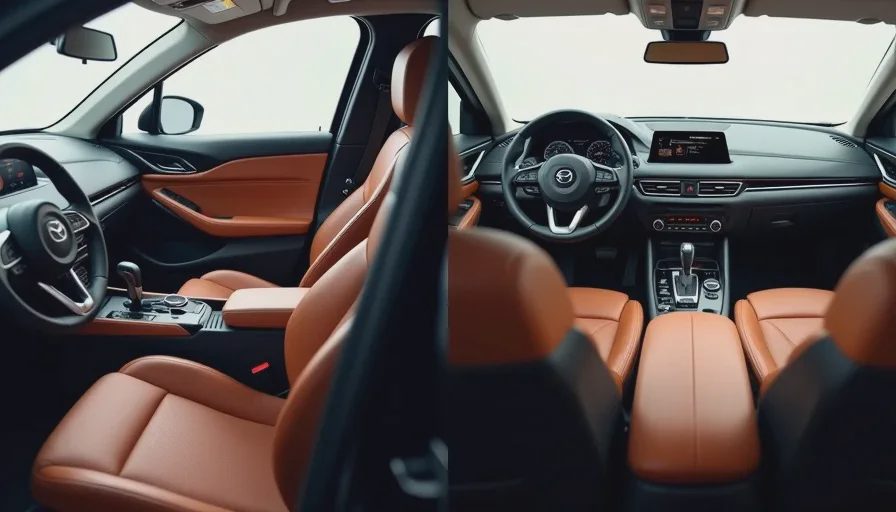
Horizontal, uncluttered design. Mazda's interiors have a clean, minimalist layout. The dashboard is low, the centre console is wide, and the lines are horizontal. It's a design that feels spacious and calm.
Driver-centric layout. The controls are focused on the driver. The instruments are easy to read, the steering wheel is perfectly positioned, and the infotainment screen is angled toward the driver.
Simple and intuitive controls. Mazda has resisted the trend of putting everything on a touchscreen. There are still physical buttons for the climate control, the audio, and the seat heating. It's a car that you can operate without taking your eyes off the road.
Attention to detail. The stitching, the stitching pattern, the lighting, the vent design — everything is considered. It's a design that rewards close inspection.
How it compares:
BMW and Mercedes: BMW's interiors are functional and well-designed, but they're not as cohesive as Mazda's. Mercedes's interiors are beautiful, but they're also flashy and distracting.
Audi: Audi's interiors are clean and minimalist, but they're also cold. The materials are good, but the design lacks warmth.
Volvo: Volvo's interiors are clean and minimalist, but they're also a bit stark. The Scandinavian design is beautiful, but it's not as inviting as Mazda's.
The verdict: Mazda's interiors are as well-designed as any car in the luxury segment.
3. Ergonomics
A great interior isn't just about looks — it's about how the car fits you. The seats should be comfortable, the controls should be easy to reach, and the visibility should be good.
What Mazda does well:
Supportive seats. The seats are comfortable for long drives. They have good lower back support, adjustable lumbar support, and side bolsters that hold you in place.
Intuitive controls. The controls are easy to reach and easy to use. The climate controls are physical buttons. The audio controls are on the steering wheel. The infotainment system is controlled by a rotary dial — no reaching for a touchscreen.
Good visibility. The windows are large, the pillars are slim, and the view out is clear. The interior feels spacious and airy.
How it compares:
Lexus: Lexus seats are comfortable, but they're not as supportive. The controls are good, but the infotainment system is frustrating.
Volvo: Volvo's seats are the most comfortable in the industry. The ergonomics are excellent. But the infotainment system is all on a touchscreen, which is frustrating.
Genesis: Genesis has good seats and good ergonomics. The controls are excellent. But the design is less cohesive than Mazda's.
The verdict: Mazda's ergonomics are as good as any car in the luxury segment.
4. Technology
This is where Mazda diverges from the competition. Instead of putting a giant, tablet-like screen in the middle of the dashboard, Mazda uses a smaller screen and a rotary controller.
What Mazda does well:
The rotary controller. The infotainment system is controlled by a rotary dial on the centre console. It's intuitive, it's easy to use, and it keeps your eyes on the road.
The head-up display. The head-up display is clear, crisp, and shows the speed, the navigation, and the safety alerts. It's one of the best in the industry.
The instrument cluster. The digital instrument cluster is crisp and clear. The layout is simple, and the information is easy to read.
The sound system. The Bose sound system (available on higher trims) is one of the best in the segment.
How it compares:
Genesis: Genesis has a large, high-resolution screen and a rotary controller. The technology is excellent.
BMW: BMW has a large screen and a rotary controller. The technology is excellent.
Volvo: Volvo has a large, tablet-like screen. The technology is impressive, but it's distracting.
Lexus: Lexus's infotainment system is the worst in the luxury segment. The touchpad is frustrating, and the interface is confusing.
The verdict: Mazda's approach to technology — a smaller screen and a rotary controller — is the most intuitive and least distracting.
The Models to Watch
Mazda CX-90
The CX-90 is Mazda's flagship. It's a three-row SUV with a 3.3-litre inline-six engine and an interior that's genuinely luxurious. The materials are high-quality, the design is beautiful, and the ergonomics are excellent. It's the best interior Mazda has ever built.
The highlights:
Nappa leather seats with quilting and perforation.
Real wood and metal trim.
A 12.3-inch digital instrument cluster.
A 12.3-inch infotainment screen controlled by a rotary dial.
A head-up display.
A 12-speaker Bose sound system.
Heated and ventilated front seats.
Heated rear seats.
A panoramic sunroof.
The verdict: The CX-90's interior is as good as any car under $50,000 — and better than some cars that cost much more.
Mazda CX-70
The CX-70 is the two-row version of the CX-90. It has the same interior design, the same materials, and the same technology. The only difference is the absence of the third row.
The highlights: Same as the CX-90.
The verdict: The CX-70 is the best two-row SUV interior under $50,000.
Mazda CX-50
The CX-50 is a compact SUV. It's smaller than the CX-5, but it's more rugged and more stylish. The interior is not as luxurious as the CX-90's, but it's still excellent for its price point.
The highlights:
Soft-touch materials on the dashboard and door panels.
A 10.25-inch infotainment screen controlled by a rotary dial.
A panoramic sunroof.
Heated and ventilated front seats.
A Bose sound system.
The verdict: The CX-50 has the best interior in the compact SUV segment.
Mazda3
The Mazda3 is a compact car. It's not a luxury car — but the interior feels like one. The materials are high-quality, the design is clean and elegant, and the ergonomics are excellent.
The highlights:
Soft-touch materials on the dashboard and door panels.
An 8.8-inch infotainment screen controlled by a rotary dial.
A head-up display.
A 12-speaker Bose sound system.
The verdict: The Mazda3 has the best interior in the compact car segment — and it's better than many luxury cars.
The BMW Comparison
Let me give you a concrete comparison.
A 2024 BMW X3 xDrive30i starts at $48,000. The interior is well-built, functional, and high-quality. But it's also conservative and uninteresting. The design hasn't changed in years. The materials are good, but they're not special.
A 2024 Mazda CX-70 starts at $42,000. The interior is beautiful, well-built, and high-quality. The design is modern and interesting. The materials are as good as the BMW's. The technology is more intuitive.
The Mazda is $6,000 cheaper and has a better interior. That's not a comparison. That's an argument for buying a Mazda.
What I've Seen on My Lift
I've worked on Mazdas for years. The interiors hold up well. The materials don't fade or crack. The seats don't sag or wear out. The switches and buttons don't break.
What I've seen:
2017 Mazda3 with 80,000 miles: The interior looks nearly new. The leather is still soft. The plastics are still dark and rich.
2019 CX-5 with 60,000 miles: The interior is still clean and quiet. No rattles, no squeaks, no worn-out materials.
2020 Mazda6 with 50,000 miles: The interior is still beautiful. The design is timeless.
The verdict: Mazda's interiors are durable. They last.
The Family Test
I put a CX-90 through the Keller family test.
Mia's take: She loved the rear seat. The legroom is generous, the rear air vents work well, and the USB-C ports are a nice touch. She said: "It's like a spaceship — but a cozy one. I like it."
Socket's take: The cargo area is 40.0 cubic feet — enough for him to stand and turn around. He had room to stretch out. He gave it a tail-wag of approval — high praise from Socket.
Claire's take: She drove it for a day. Her feedback: "The seats are comfortable. The interior is quiet. The controls are easy to use. I didn't have to think about anything. I just drove home. It's not as comfortable as the Volvo, but it's close."
My take: Mazda is building the best interiors under $50,000. Period. The materials are high-quality, the design is beautiful, the ergonomics are excellent, and the technology is intuitive. It's a car that rewards you every time you get in.
The Bottom Line
Mazda is building the best interiors under $50,000. The materials are as good as BMW's. The design is as good as Audi's. The ergonomics are as good as Volvo's. And the price is lower than all of them.
If you're shopping for a luxury car under $50,000, you owe it to yourself to drive a Mazda. The CX-70, the CX-90, and the CX-50 all have interiors that are class-leading — and they're cheaper than anything from BMW, Mercedes, or Audi.
Socket's Final Verdict
Socket doesn't care about interiors. He cares about cargo space and the smell of the seats.
But he did give the CX-90 a tail-wag of approval. He liked the cargo area, he liked the low load height, and he liked the heated rear seats.
That's a win.





No signals yet — transmit the first.