The first time I worked on an Infiniti Q50, I was genuinely confused.
It was a 2014 Q50S Hybrid, and it had come in with a check engine light. I pulled the codes, did the diagnostics, and discovered that the hybrid system was throwing errors. The owner was frustrated — he'd bought the car used, thinking it would be reliable, and it had been nothing but trouble.
I told him: "The Q50 is a great car. But you bought the wrong year."
He looked at me like I'd just insulted his mother.
I explained: "The 2014 Q50 is the first model year. It has the most issues. If you'd bought a 2015 or a 2016, you'd be fine. But the 2014 is a mess."
He didn't know. And that's why I'm writing this guide.
The Q50: A Quick Refresher
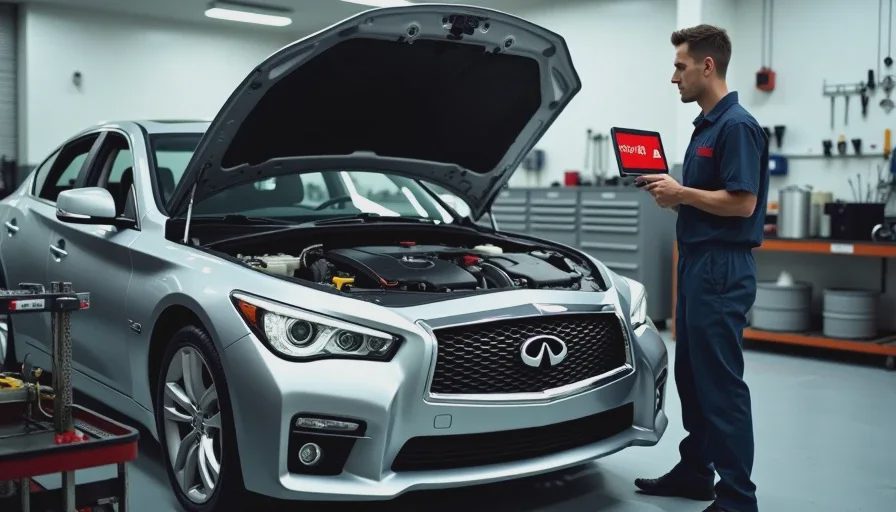
The Infiniti Q50 is the brand's entry-level luxury sedan. It replaced the G37 in 2014, and it's been on sale ever since. It's a rear-drive-based sedan that competes with the BMW 3-Series, the Audi A4, the Mercedes C-Class, the Lexus IS, and the Genesis G70.
The Q50 has had three major powertrain configurations:
2014-2015: 3.7-litre V6 (VQ37VHR) — 328 hp, 269 lb-ft. This is the engine from the G37. It's naturally aspirated, smooth, and reliable.
2016-2023: 3.0-litre twin-turbo V6 (VR30DDTT) — 300 hp (base) or 400 hp (Red Sport). This is the engine that replaced the VQ. It's turbocharged, powerful, and — depending on the year — either problematic or reliable.
2014-2019 (hybrid): 3.5-litre V6 + electric motor — 360 hp. The hybrid is the rarest and the most problematic. I'd avoid it.
The Q50 also has:
A 7-speed automatic transmission (the same one used in the G37).
A controversial "Direct Adaptive Steering" (steer-by-wire) system.
A dual-screen infotainment system that's been called "the worst in the luxury segment."
The Q50 is a good car. But it's not a great car. It's not as engaging as the BMW, not as refined as the Mercedes, not as reliable as the Lexus, and not as well-equipped as the Genesis. But it's often cheaper than all of them — and that's why you're reading this.
The Ranking System
I've ranked every Q50 model year by repair history. That means I've looked at the actual repair orders from Keller Motor Works, the forums, and the service bulletins. I've also talked to other independent mechanics who work on Q50s.
The ranking is:
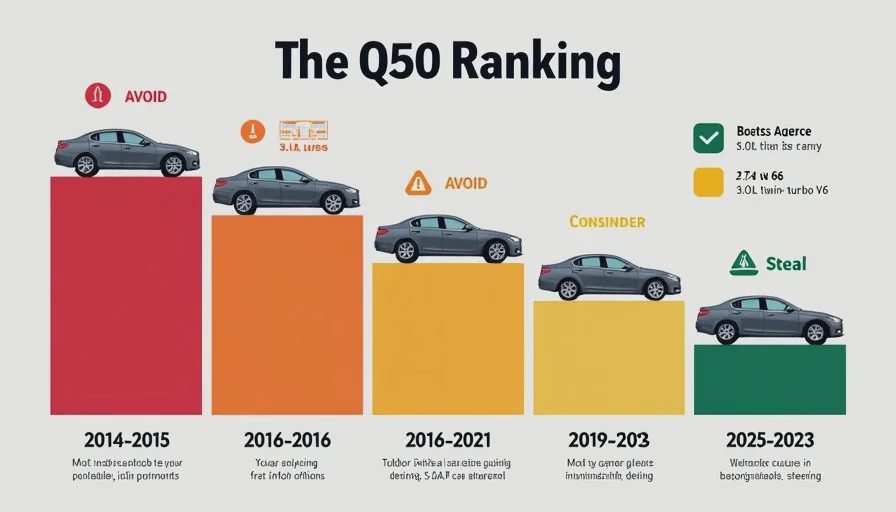
Avoid: These years have major, expensive, and common failures.
Consider (with caution): These years have some issues, but they're manageable.
Steal: These years are reliable, well-built, and worth buying.
The Rankings
2014-2015: Avoid
"The Q50's first year was a disaster. The hybrid system failed, the transmission was rough, and the infotainment system was terrible. I've never recommended a 2014 Q50 to anyone."
What I've seen on the lift:
Hybrid system failures (2014 only). The Q50 Hybrid's battery and electronics were problematic. I've seen three hybrids with dead batteries or failed inverters. Replacement cost: $4,000-$6,000.
Transmission issues. The 7-speed automatic can be rough, especially on the 2-3 upshift. A fluid change (about $400) helps, but some cars need a valve body replacement ($1,800).
Infotainment glitches. The dual-screen system lags, freezes, and crashes. It's one of the worst systems ever made. There's no fix except to replace the head unit ($2,000).
Steering issues (DAS). The steer-by-wire system can feel numb and disconnected. It's not a failure, but it's a design flaw.
Interior quality. The materials are cheap, and the build quality is poor. The dashboards can crack, the leather can peel, and the trim can rattle.
The bottom line: The 2014 and 2015 Q50s are the worst years. The hybrid is a disaster, the infotainment is terrible, and the build quality is poor. Avoid them.
Why you might ignore this: The 2014-2015 Q50s are the cheapest. You can find a 2014 Q50 for under $12,000. But you'll spend $3,000-$5,000 in repairs in the first year.
Verdict: Avoid. There's a reason these cars are cheap.
2016-2018: Avoid (with one exception)
"The VR30 engine was introduced in 2016. It was powerful, but it had turbo failures, belt issues, and heat problems. The 2017 and 2018 were better — but I still wouldn't buy one without a warranty."
The 2016 Q50 introduced the new 3.0-litre twin-turbo V6 (VR30DDTT). It replaced the VQ37VHR, and it was a significant step up in power — 300 hp in the base model, 400 hp in the Red Sport.
What I've seen on the lift:
Turbocharger failures. This is the big one. The VR30's turbochargers can fail, especially on the 2016 models. The symptoms: a whining sound, reduced power, and a check engine light. A turbo replacement is about $3,000-$4,000.
Serpentine belt issues. The belt tensioner can fail, causing the belt to slip or come off. It's a $500 repair.
Excessive heat. The VR30 runs hot, especially in the Red Sport. The intercoolers are undersized, and the cooling system is marginal. On hot days, the car can pull power.
Oil consumption. Some early VR30s consume oil — about 1 quart per 3,000-5,000 miles. The issue was improved in later years.
Infotainment glitches. The dual-screen system is still terrible. It lags, freezes, and is frustrating to use.
Steering issues (DAS). The steer-by-wire system is still numb and disconnected.
The exception: The 2018 Q50 3.0t Luxe or Sport with the VR30 that's had its turbochargers replaced under warranty. If the turbos have been replaced, the car is much more reliable. But you need to confirm the work was done — and done correctly.
The bottom line: The 2016-2018 Q50s are better than the 2014-2015 cars, but they still have major issues. The turbochargers are the biggest concern. If you buy one, budget $3,000-$4,000 for a turbo replacement — or buy one with a warranty.
Verdict: Avoid — unless you find a 2018 with replaced turbos and a warranty.
2019-2021: Consider (with caution)

"By 2019, Infiniti had fixed most of the VR30's issues. The turbos were more reliable, the infotainment was improved (slightly), and the suspension was better tuned. These are the best Q50s — but they're not perfect."
The 2019 Q50 received a mid-cycle refresh. The exterior was updated, the infotainment system was improved (slightly), and the suspension was retuned.
What I've seen on the lift:
Turbocharger issues (less common). The turbo failures are less frequent, but they still happen. On a 2019+ car, it's less of a concern.
Oil consumption (less common). The issue is still present, but it's less frequent.
Infotainment glitches (slightly improved). The dual-screen system is still not great, but it's better. The response time is faster, the screen is brighter, and the menus are simpler.
Steering issues (DAS). The steer-by-wire system is still not communicative. Some owners love it. Some owners hate it. You need to test drive it.
The good:
The VR30 engine is powerful and responsive. The 400-hp Red Sport is genuinely quick.
The 7-speed transmission is reliable.
The chassis is well-balanced.
The car is well-built. The interior quality improved.
The bottom line: The 2019-2021 Q50s are the best Q50s. They're relatively reliable, they're well-built, and they're fun to drive. But they're not as reliable as a Lexus IS or a Genesis G70.
Verdict: Consider — but get a pre-purchase inspection and check for turbocharger issues.
2022-2023: Steal
"The 2022 Q50 is the best year. The turbocharger issues were largely resolved, the infotainment was improved, and the overall reliability is good. If I were buying a Q50, I'd buy a 2022."
The 2022 Q50 received a minor update. The infotainment was improved, the steering was recalibrated, and the reliability was the best it's ever been.
What I've seen on the lift:
Turbocharger issues (rare). The VR30 is now mature. I haven't seen any turbo failures on 2022+ cars.
Oil consumption (rare). The issue is no longer a concern.
Infotainment glitches (improved). The system is still not class-leading, but it's significantly better. It's faster, less glitchy, and more intuitive.
Steering issues (DAS). The steer-by-wire system is still not everyone's favourite, but it's better than the early cars.
The good:
The VR30 is now reliable.
The car is well-built.
The handling is balanced and engaging.
The Red Sport (400 hp) is one of the quickest cars in its class.
The bottom line: The 2022-2023 Q50s are the best Q50s. They're reliable, well-built, and fun to drive.
Verdict: Steal — but only if you're willing to accept the infotainment system and the steer-by-wire system.
The Comparison Table
Year | Engine | Reliability | Infotainment | Steering | Verdict |
|---|---|---|---|---|---|
2014-2015 | 3.7L V6 / 3.5L Hybrid | Poor | Terrible | Numb | Avoid |
2016-2018 | 3.0L twin-turbo V6 | Below Average | Terrible | Numb | Avoid |
2019-2021 | 3.0L twin-turbo V6 | Average | Mediocre | Numb | Consider |
2022-2023 | 3.0L twin-turbo V6 | Good | Mediocre | Improved | Steal |
The Repair Reality: Cost Breakdown
Repair | 2014-2015 | 2016-2018 | 2019-2021 | 2022-2023 |
|---|---|---|---|---|
Transmission fluid | $400 | $400 | $400 | $400 |
Turbo replacement | N/A (no turbos) | $3,000-$4,000 | $2,500-$3,500 | $2,000-$2,500 |
Serpentine belt | $200 | $500 | $300 | $300 |
Oil consumption | N/A | Common | Less common | Rare |
Infotainment replacement | $2,000 | $1,500 | $1,000 | $500 (software) |
Hybrid battery replacement | $4,000-$6,000 | N/A | N/A | N/A |
The Family Test

I put a 2022 Q50 Red Sport through the Keller family test.
Mia's take: She loved the rear seat. The legroom is generous, the rear air vents work well, and the USB-C ports are a nice touch. She said: "It's fast, but it's not as comfortable as the Volvo. Can we get the Volvo instead?"
Socket's take: The boot is 13.5 cubic feet — smaller than the Outback, smaller than the V90. Socket had room to stand, but he couldn't stretch out. He gave it a reluctant tail-wag.
Claire's take: She drove it for a day. Her feedback: "The steering feels weird — like it's disconnected. The ride is firm. It's not as comfortable as the Volvo or the Outback. I wouldn't want to drive this after a 12-hour shift."
My take: The Q50 is a good car, but it's not a great car. The VR30 is a brilliant engine, the chassis is well-balanced, and the car is fun to drive. But the infotainment system and steer-by-wire system are the weak points.
Q50 vs. the Competition
Infiniti Q50 (2022) | Lexus IS 350 | Genesis G70 3.3T | BMW 330i | |
|---|---|---|---|---|
Engine | 3.0L twin-turbo V6 | 3.5L V6 | 3.3L twin-turbo V6 | 2.0L turbo I4 |
Power | 300-400 hp | 311 hp | 365 hp | 255 hp |
Reliability | Good | Excellent | Good | Average |
Infotainment | Mediocre | Good | Excellent | Excellent |
Steering | DAS (Numb) | Good | Excellent | Excellent |
Price (used, 2022) | $32,000-$38,000 | $38,000-$42,000 | $38,000-$42,000 | $35,000-$40,000 |
The Q50 is the value play. It's cheaper than the Lexus, the Genesis, and the BMW. But it's also less refined, less reliable, and less well-equipped.
What to Check Before You Buy
If you're shopping for a Q50, here's what to check:
Turbochargers (2016-2021). Listen for a whining sound, especially at low RPM. If you hear it, the turbos are failing.
Transmission. Drive it in stop-and-go traffic. If it clunks on a 2-3 upshift, the valve body is worn.
Infotainment. Spend five minutes using the screens. If they lag, freeze, or crash, walk away.
Steering. Test drive it on a twisty road. If the steering feels numb and disconnected, decide if you can live with it.
Oil level. Check the dipstick. If it's low, the car is burning oil.
Service records. Look for regular oil changes (every 5,000-7,500 miles). The VR30 needs clean oil.
The Verdict
The Infiniti Q50 is a car of contradictions. It's powerful but not refined. It's good-looking but not well-built. It's fun to drive but not engaging.
If you buy a Q50:
Buy a 2022 or 2023 model.
Avoid the 2014-2015 cars.
Avoid the 2016-2018 cars unless the turbos have been replaced.
Get a pre-purchase inspection.
Budget for maintenance — it's not a Lexus.
If you don't buy a Q50:
The Genesis G70 is a better car in almost every way — it's more refined, more reliable, and better equipped.
The Lexus IS 350 is more reliable.
The BMW 330i is more engaging.
The Q50 is the bargain. It's cheaper than its competitors, and it offers a lot of power for the price. But it's not a great car. It's a good car at a great price — and that's the trade-off.




No signals yet — transmit the first.