
The first time I saw a VC-Turbo engine with the cylinder head off, I spent ten minutes just staring at the crankshaft.
I'm not easily impressed. I've been turning wrenches for fifteen years, and I've seen pretty much every engine architecture you can name—inline-fours, V6s, flat-sixes, rotaries, even a few Wankels. But this? This was different. This was an engine that changes its own compression ratio while it's running.
It's the kind of engineering that sounds like science fiction. And when Infiniti launched it in 2019, nobody really understood it—not the journalists, not the buyers, not even some of the technicians I trained.
That's a shame. Because the VC-Turbo is one of the most genuinely clever engines ever built. And if you're shopping for a used Infiniti QX50 or Q50, you need to know how it works—and whether you want to own one.
What's a Compression Ratio, and Why Should You Care?
Let me back up for a second.
In any petrol engine, the piston moves up and down inside the cylinder. When the piston is at the bottom, the cylinder is full of air and fuel. When the piston moves to the top, it compresses that mixture before the spark plug ignites it.
The compression ratio is the difference between the volume of the cylinder at the bottom (maximum volume) and the volume at the top (minimum volume). If the bottom volume is 10 times the top volume, you have a 10:1 compression ratio.
Higher compression ratio = more power and efficiency, because the fuel burns more completely. But there's a catch: if the compression ratio is too high, the fuel can ignite prematurely—a phenomenon called "knock" or "detonation." That's why high-performance engines run on premium fuel: the higher octane prevents knock.
Now here's the problem. An engine with a fixed compression ratio is always a compromise. If you set it high (like 12:1), you get great efficiency on the highway—but you need premium fuel, and you can't run much boost from a turbocharger. If you set it low (like 8:1), you can run a big turbo and make lots of power—but you sacrifice efficiency when you're just cruising.
For decades, engineers accepted this compromise. They'd pick a ratio somewhere in the middle—9:1, 10:1—and call it a day.
Nissan's engineers decided that wasn't good enough. They wanted an engine that could have both: high compression for efficiency, low compression for power, and the ability to switch between them on the fly.
That's the VC-Turbo.
How It Works (the simple version)
Imagine you have a lever that can change the height of your office chair. You can lower it for a more aggressive, sporty posture. Or raise it for a more relaxed, comfortable one.
The VC-Turbo does the same thing—but for the piston stroke.
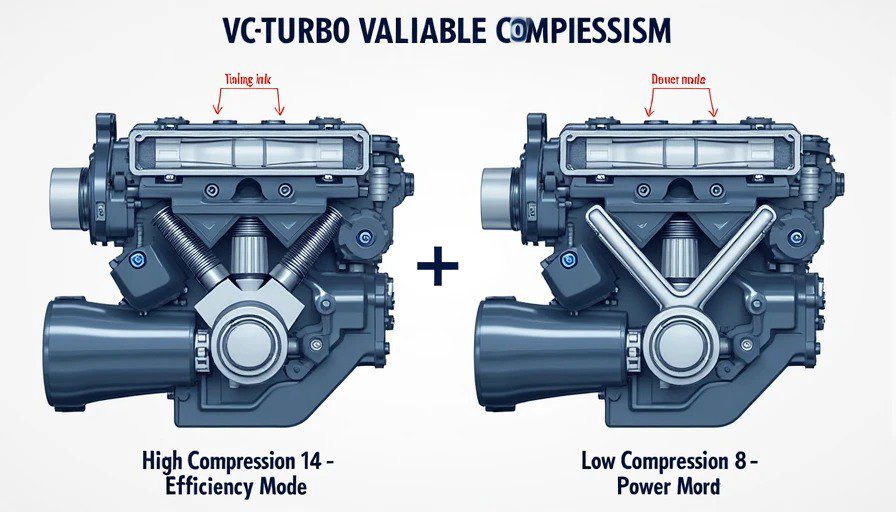
Instead of a traditional connecting rod that's fixed in length, the VC-Turbo uses a multi-link mechanism at the bottom of the engine. It's a series of linkages that can change the position of the crankshaft relative to the cylinder head.
Here's the actual engineering:
The piston connects to a traditional connecting rod.
That connecting rod attaches to a lower link—a pivoting arm.
The lower link is attached to the crankshaft on one side, and to an actuator arm on the other side.
An electric motor (with a reduction gear) rotates the actuator arm, which changes the position of the lower link.
When the actuator arm moves one way, the effective length of the connecting rod changes, and the piston reaches a different height at the top of its stroke. That changes the compression ratio.
The system can adjust the compression ratio continuously from 8:1 to 14:1, and it can do it while the engine is running. It takes about 1.2 seconds to go from one extreme to the other, and the driver never feels it happening.
It's brilliant.
What It Feels Like to Drive
I've driven the VC-Turbo in the QX50 and the Q50. The experience is... interesting.
At low throttle—cruising on the highway, maintaining speed—the compression ratio goes up to 14:1. The engine is efficient, and it feels smooth and responsive. You wouldn't know anything unusual is happening.
When you floor it, the compression ratio drops to 8:1. The turbocharger (which is a twin-scroll unit) spools up, and the engine makes its full 268 horsepower and 280 lb-ft of torque. The engine note changes—it gets a bit deeper, a bit more purposeful—but the transition is seamless.
The result is a 2.0-litre four-cylinder that feels like a 3.5-litre V6. It's not explosive, but it's always ready. There's no turbo lag, no flat spots, no waiting for the power to arrive. It just goes when you ask it to.
The fuel economy is genuinely impressive. The QX50 (a heavy SUV) gets 26 mpg combined—and that's with 268 horsepower. For comparison, a BMW X3 with a 2.0-litre turbo gets about 25 mpg combined. The Infiniti is slightly more efficient, and it makes more power.
The Real Question: Is It Reliable?
Here's where we get to the part that matters.
I've had about a dozen VC-Turbos come through Keller Motor Works. Some for routine maintenance, some for issues, and a few for post-warranty inspections.
The good news:
The compression change mechanism itself is surprisingly robust. I've seen cars with 80,000 miles on them, and the actuator arm and linkage show minimal wear. The electric motor is sealed and reliable. I haven't had to replace one yet.
The turbocharger is solid. It's a proven twin-scroll design, and it's not over-stressed. The engine's ability to lower compression means the turbo can run more boost safely, but the actual hardware is conservative.
The bottom end is strong. The crankshaft is forged steel, the connecting rods are high-strength alloy, and the main bearings are large and well-supported. This engine is overbuilt for its power output—and that's a good thing.
The less good news:
Oil consumption. This is the big one. The VC-Turbo has a reputation for burning oil—about 1 quart every 3,000-5,000 miles. I've seen it on multiple cars. It seems to be caused by the piston rings, which are a bit thin to accommodate the multi-link mechanism's packaging. It's not catastrophic, but it's annoying. Carry a quart in the boot and check the oil level every 2,000 miles.
The PCV system. The crankcase ventilation system on the VC-Turbo is complex—it has to accommodate the variable stroke, so there are more seals and more opportunities for leaks. The PCV diaphragm (same as on the Volvo engines) can fail, causing a whistling sound. The part is cheap—about $30—and it's a 45-minute fix. But it's a common failure.
The water pump. I've seen two VC-Turbos with leaking water pumps around 60,000 miles. The pump is mounted on the front of the engine, so it's not a difficult job—about $600 at an indie shop. But it's a common failure point.
The high-pressure fuel pump. This is the only component that's genuinely expensive. The direct-injection system uses a high-pressure pump that's driven by the camshaft. It's a Bosch unit, and it can fail, causing a check-engine light and reduced power. The pump is about $1,200, and it's a two-hour job.
The CVT (QX50 only). If you're buying a QX50, pay close attention to the transmission. The VC-Turbo is mated to a CVT (continuously variable transmission)—and it's not Infiniti's best effort. The CVT can feel rubber-bandy, especially under hard acceleration. It's not unreliable, but it's uninspiring. The Q50 (sedan) uses a 7-speed automatic, which is much better.
What I Tell My Customers
When someone asks me about the VC-Turbo, I give them a simple assessment:
"This engine is a brilliant piece of engineering. But it's also a first-generation design—and first-gen designs always have quirks. The compression-change mechanism is reliable. The bottom end is strong. But the piston rings are thin, and some cars burn oil. The PCV system needs attention. The water pump is a common failure at 60,000 miles. And if you're buying a QX50, the CVT is the weak link."
"If you're okay with that—if you're willing to check the oil level regularly and budget for a few common repairs—the VC-Turbo is a fantastic engine. It's efficient, responsive, and genuinely fun to drive. But if you want a low-maintenance car, look elsewhere. The Volvo T5 or the Mazda 2.5-litre is simpler and more forgiving."
The Buying Guide
If you're shopping for a VC-Turbo-equipped Infiniti, here's what you need to know:
QX50 (SUV)
The sweet spot: 2020–2021 QX50 Sensory or Autograph trim. These cars have the most features and the best depreciation curve. Prices have dropped sharply—you can find a 2020 with 30,000 miles for about $30,000.
What to check:
Oil level. Check the dipstick. If it's low, the car is burning oil. Negotiate accordingly.
CVT behaviour. Drive it in stop-and-go traffic. If the CVT feels jerky or hesitant, walk away or budget for a transmission fluid change (about $400).
Water pump. Listen for a whining sound from the front of the engine—it could be the water pump bearings.
Service records. The engine needs regular oil changes with the correct grade (0W-20). If there's no record, assume the oil was neglected.
Q50 (Sedan)
The sweet spot: 2019–2020 Q50 Luxe or Sport. The Q50 is lighter than the QX50, and the 7-speed automatic makes better use of the engine's power. Prices are lower, too—a 2019 Q50 with 40,000 miles is about $22,000–$25,000.
What to check:
Same as the QX50, plus:
Transmission behaviour. The 7-speed is reliable, but it can be a bit clunky on the 2-3 upshift. A fluid change ($300) often fixes it.
Steering. The Q50 has Infiniti's "Direct Adaptive Steering" (steer-by-wire), which is controversial. Some drivers love it; some hate it. Drive it and decide for yourself.
Years to Avoid
2019 (first year): The VC-Turbo launched in the 2019 QX50. Early production units had a few issues—oil consumption was worse, the PCV system failed more frequently, and the CVT had more software glitches. Later builds (mid-2020+) are better.
2022+: (budget not worth it): The VC-Turbo was updated in 2022 with some internal refinements. But the prices are still in the high $30,000 range—and at that point, you're close to a Volvo T5 or a Genesis G70, which are better cars in most respects.





No signals yet — transmit the first.