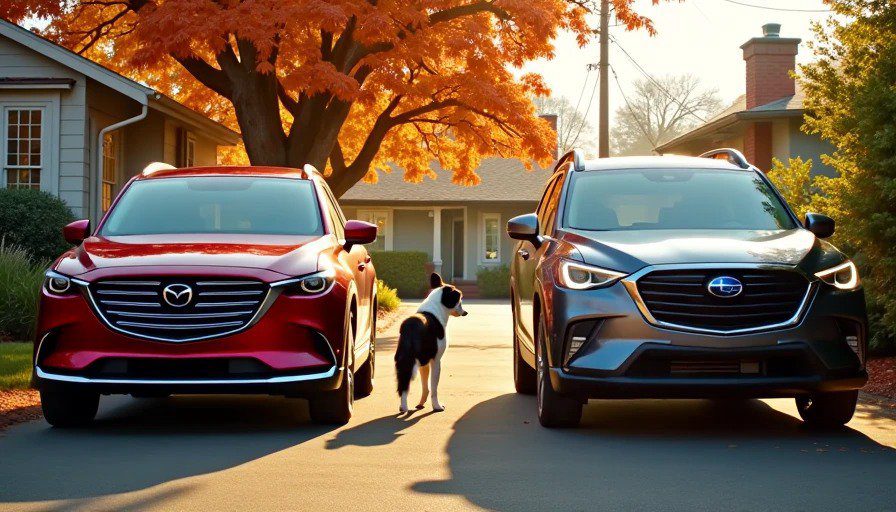
Let me set the scene.
It's a Saturday morning in Southeast Portland. The rain has finally stopped, which means every dog owner in a 10-mile radius is heading to the same off-leash park. Socket is pacing by the front door, doing his pre-walk ritual—circling, whining, and giving me the look that says: "I know you're about to put me in a car. Make it a good one."
I had two SUVs in the driveway that week. A 2024 Mazda CX-90 Turbo S Premium Plus (borrowed from a customer who was out of town) and a 2023 Subaru Ascent Touring (a loaner from a local dealer who wanted my honest opinion—and got it).
Two three-row SUVs. Two very different philosophies. One border collie who doesn't care about horsepower figures but absolutely cares about cargo area geometry.
Socket and I spent a week living with both cars. School runs, Costco hauls, muddy dog park trips, and a camping shakedown. Here's what we learned.
The Contenders
2024 Mazda CX-90 Turbo S Premium Plus
Mazda's new flagship SUV is a statement. It's built on a rear-biased all-wheel-drive platform—the same architecture that underpins the new CX-70. Under the bonnet is a 3.3-litre turbocharged inline-six (yes, a six-cylinder in a Mazda) making 340 horsepower and 369 lb-ft of torque. It's the most powerful production Mazda ever built.
Key dimensions:
Wheelbase: 122.8 inches
Length: 201.6 inches
Width: 78.3 inches
Height: 68.2 inches
Cargo capacity (behind 3rd row): 14.9 cubic feet
Cargo capacity (behind 2nd row): 40.0 cubic feet
Cargo capacity (all seats down): 74.2 cubic feet
The CX-90 is a looker. It's long, low, and muscular—almost like a wagon that got stretched. The interior is Mazda's best work yet: Nappa leather, real metal trim, and a dash design that feels genuinely premium.
2023 Subaru Ascent Touring
Subaru's largest SUV is the opposite philosophy. It's built on the Subaru Global Platform, with a 2.4-litre turbocharged flat-four making 260 horsepower and 277 lb-ft. It's not as powerful, not as stylish, and not as sporty. But it's a Subaru—which means it's practical, durable, and designed for families who actually use their cars.
Key dimensions:
Wheelbase: 113.8 inches (shorter)
Length: 196.8 inches (shorter by 4.8 inches)
Width: 76.0 inches (narrower by 2.3 inches)
Height: 71.6 inches (taller by 3.4 inches)
Cargo capacity (behind 3rd row): 17.8 cubic feet
Cargo capacity (behind 2nd row): 47.3 cubic feet
Cargo capacity (all seats down): 86.6 cubic feet
The Ascent is shorter but taller, and it's designed to maximize interior volume. It's not pretty, but it's honest—and that's exactly what Subaru buyers want.
Socket's Cargo Test: The Methodology
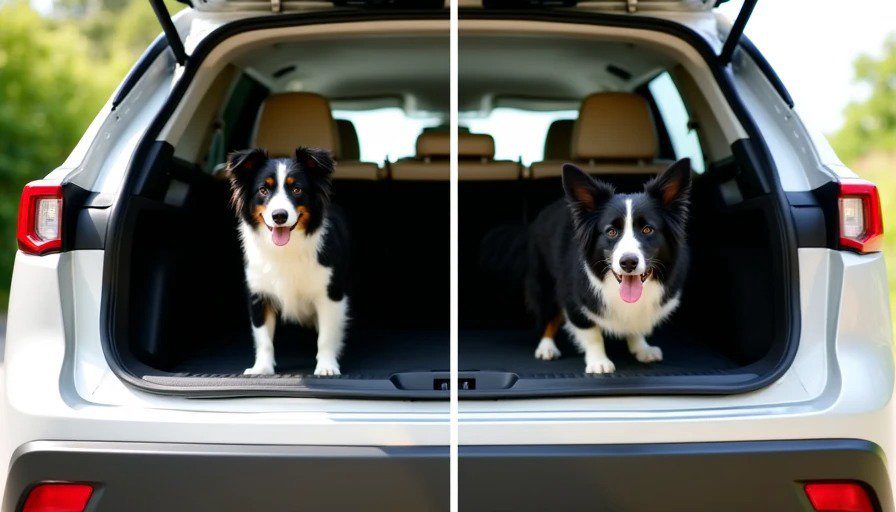
Socket is a 22-kilogram border collie mix. He's not huge, but he's not small—he's the size of a medium dog with the energy of a large one. For this test, I used three criteria:
Can he stand up and turn around? This is the minimum. If he can't turn around without hitting the roof or the seats, it's a fail.
Can he lie down comfortably? He needs to stretch out fully. If he has to curl up, it's a pass, but not a high one.
Can he jump in and out without assistance? The load height matters—if it's too high, he hesitates. If it's too low, he's fine.
I also tested with the third row up (family mode) and with the third row folded (dog mode). Because most people aren't hauling six passengers and a dog at the same time—but if you are, you need to know.
The Mazda CX-90: First Impressions
The CX-90's cargo area is, on paper, the smallest of the two. Behind the third row, you get 14.9 cubic feet—enough for a few grocery bags or a couple of backpacks. It's not generous.
Socket approached the open tailgate, put his front paws on the bumper, and hesitated. The load height is about 30 inches—not terrible, but higher than the Ascent. He needed a small hop to get in.
Once inside, he stood up. His ears just brushed the roofliner—he could stand, but it was close. He turned around, which took a bit of maneuvering because the cargo area is narrow (the wheel arches intrude significantly). He lay down, and he fit, but his head was against the back of the second-row seats.
Socket's initial verdict: "I can use this, but it's not my favourite."
The real problem: The CX-90's cargo floor is sloped. The third-row seats, when folded, don't lie perfectly flat—there's a slight incline toward the front. It's not a deal-breaker, but it means that if you're hauling something heavy (or a dog who likes to shift around), it slides forward.
The floor is also carpeted, which is fine for dry days but a disaster for muddy paws. Without a rubber cargo mat, the CX-90's cargo area would be a mess within a week. (Note to Mazda: the CX-90 has a rubber cargo liner as an option. Buy it.)
Mia's Take (Second-Row Experience)
Mia sat in the second row, directly in front of Socket. Her booster seat was on the passenger side, and she had a clear view of the driver's seat. The legroom is generous—she had plenty of space for her feet, and the reclining rear seats allowed her to lean back comfortably.
Her feedback: "It's nice back here. The seats are comfy. But can we roll the window down?" (The second-row windows roll down almost fully, which is a win.)
Claire's Take (Driving)
Claire drove the CX-90 for a day. Her feedback:
"This thing drives like a sport sedan. It's huge, but it doesn't feel huge. The steering is sharp, and the power is effortless. But the ride is firm—I felt every bump in the road. Is that good or bad?"
I told her it depends on what you want. If you want a luxury SUV that's engaging to drive, the CX-90 is the best in its class. If you want a plush, isolated ride, you might prefer the Volvo XC90 or a Lexus.
She nodded. "I think I'd prefer a softer ride. This is a family car, not a sports car."
The Camping Test
I loaded the CX-90 for a weekend camping trip. Two adults, one kid, one dog, and about 40 kilograms of gear: tent, sleeping bags, cooler, camp chairs, and a bag of firewood.
With the third row folded, the CX-90 had 40.0 cubic feet of cargo space. I fitted all the gear with room to spare—but just barely. The sloped roofline and the narrow cargo area made it a bit of a puzzle to pack. The cooler went in first, then the tent, then the sleeping bags. I had to be strategic.
Verdict: It works for a family of three. If you have four or five people and need to carry gear, you'd struggle.
The Subaru Ascent: First Impressions
The Ascent's cargo area is noticeably taller and wider. Behind the third row, you get 17.8 cubic feet—about 20% more than the CX-90. It's enough for a full Costco haul, or a week's worth of groceries, or a couple of large suitcases.
Socket approached the tailgate with confidence. The load height is about 27 inches—lower than the CX-90. He jumped in without hesitation.
Inside, he stood up and looked around. He had several inches of headroom—no contact with the roofliner. He turned around easily, with plenty of clearance. He lay down, stretched out fully, and sighed. That's the sign of a happy dog.
Socket's initial verdict: "This is more like it."
The cargo floor is flat—the third-row seats fold nearly flush with the floor, creating a continuous surface. The floor is carpeted, but Subaru makes a rubber cargo mat that's sold as an accessory. I'd strongly recommend it.
Mia's Take (Second-Row Experience)
Mia sat in the second row of the Ascent. The captain's chairs are comfortable and roomy, and she had plenty of legroom. The second-row windows are large and let in a lot of light.
Her feedback: "I like this one better. It feels bigger inside. And I can see out the window more."
(She also appreciated the cup holders in the door pockets—she's at that age where cup holder placement is a critical evaluation metric.)
Claire's Take (Driving)
Claire drove the Ascent for a day. Her feedback:
"It's... fine. It drives like a car. It's not exciting, but it's comfortable. The ride is softer than the Mazda—I didn't feel every bump. And the visibility is great—I can see everything around me."
"The steering is light, which I like. The brakes are a bit grabby, though—I had to get used to them."
She also appreciated the Ascent's size: "I can see over the bonnet more easily. The Mazda feels like a long hood that I can't quite judge."
The Camping Test
I packed the same gear into the Ascent. With the third row folded, the cargo area is 47.3 cubic feet—about 18% more than the CX-90.
The extra space made a real difference. I didn't have to play Tetris—everything fit easily. The tent went in without folding it perfectly, the cooler slid in without hitting anything, and there was still space for an extra bag of firewood.
Verdict: The Ascent is a better cargo hauler. No question.
The Cargo Test: Head-to-Head
Metric | Mazda CX-90 | Subaru Ascent | Winner |
|---|---|---|---|
Cargo (3rd row up) | 14.9 cu ft | 17.8 cu ft | Ascent |
Cargo (3rd row folded) | 40.0 cu ft | 47.3 cu ft | Ascent |
Cargo (all seats down) | 74.2 cu ft | 86.6 cu ft | Ascent |
Load height | 30 inches | 27 inches | Ascent |
Cargo floor flatness | Slight incline | Flat | Ascent |
Socket standing clearance | Ears brush roof | Inches of headroom | Ascent |
Socket turning radius | Tight but doable | Easy | Ascent |
Socket lie-down comfort | Adequate | Generous | Ascent |
The Ascent wins every single cargo metric. It's not even close.
But There's More to an SUV Than Cargo
If the cargo test was the only metric, the Ascent would be the easy winner. But it's not. The CX-90 has strengths that the Ascent can't match.
The Driving Experience
The CX-90 is genuinely fun to drive. The inline-six is smooth, responsive, and powerful—it's the best engine in this segment, bar none. The rear-biased platform gives it a sporty feel that the Ascent can't replicate. The steering is precise, the handling is flat, and the car feels much smaller than it is.
The Ascent, by contrast, is competent but uninspiring. It's a family hauler that does its job without complaint—but it doesn't put a smile on your face. The engine is adequate, the handling is safe, and the steering is light.
If you're the kind of driver who cares about the driving experience, the CX-90 is the better car. If you just want to get from point A to point B with your family, the Ascent is fine.
The Interior
The CX-90's interior is a class above the Ascent. The leather is better, the materials are richer, and the design is more cohesive. The sound system (Bose, standard on higher trims) is excellent. The seats are more supportive and more adjustable.
The Ascent's interior is functional but plain. The plastics are hard, the design is simple, and the sound system (also Harmon Kardon on the Touring) is good but not great. It's not unpleasant—it's just not premium.
The Fuel Economy
The CX-90's 3.3-litre inline-six is surprisingly efficient. I averaged 23.5 mpg combined, with a mix of city and highway driving. The Ascent's 2.4-litre flat-four is less efficient—I averaged 21.2 mpg combined.
That's a difference of about 10%—not huge, but it adds up over the life of the car. The Mazda also has a mild-hybrid system (48-volt) that adds a bit of electric assist, improving efficiency slightly.
The Reliability Picture
Both cars are too new to have a long-term reliability track record. But here's what I've seen:
The Ascent is a proven platform—the 2.4-litre engine has been in service since 2019, and the transmission (a CVT) has had its share of issues. The early Ascents (2019–2020) had transmission problems, but the 2023 models are much better. The CVT is still not my favourite, but it's reliable enough for most owners.
The CX-90 is brand new—2024 is the first model year. First-year cars always have teething issues. I've heard of a few early CX-90s with software glitches (the infotainment system, specifically) and a couple with rough transmission shifts. I'd be wary of a 2024 CX-90 until Mazda sorts out the initial issues. If you're buying one, wait for the 2025 or 2026 model.
The Repair Reality
If you're buying one of these, here's what I'd tell you:
Ascent: The CVT is the wild card. It's better than it was, but it's still a CVT—and CVTs don't like abuse. Change the transmission fluid every 60,000 miles, and you'll likely be fine. The 2.4-litre engine is solid—no major issues. The suspension is simple and durable.
CX-90: The inline-six is new, and there's not enough data yet. The first-year cars could have issues with the 48-volt system (the mild-hybrid). The transmission (also new) is an 8-speed—Mazda hasn't used this specific unit before, and there may be teething issues. The suspension is more complex than the Ascent's, which means more potential repair costs.
Verdict: The Ascent is likely to be cheaper to maintain over the first 100,000 miles. The CX-90 could be more expensive—but it's too soon to know.
Which One Should You Buy?
If you prioritize cargo space, practicality, and cost of ownership: Buy the Subaru Ascent. It's the better family hauler. Socket approves. Mia approves. Claire finds it easier to drive. It's not exciting, but it does everything you need it to do without complaint.
If you prioritize driving experience, interior quality, and style: Buy the Mazda CX-90. It's a much nicer car to live with—as long as you're willing to accept the smaller cargo area, the higher load height, and the potential for first-year teething issues. Socket won't love it as much, but you'll smile every time you drive it.
Socket's Final Verdict
After a week of testing, I put both SUVs side by side in the driveway. Socket walked to the Mazda, sniffed the tailgate, and walked away. Then he walked to the Ascent, jumped in, and sat down.
He didn't move. He just looked at me with that border collie stare—the one that says: "I've made my choice. Why are you still thinking about it?"
He's not wrong. The Ascent is the better dog car. But it's not the better car.
If I had to choose one for my family, I'd take the CX-90. Because I care about driving, and because Mia and Claire both liked the Mazda more despite its cargo limitations. And because Socket, for all his wisdom, can't tell you what a car feels like on a winding road.
But if I had a second dog? Or a third kid? Or if I went camping every weekend? The Ascent would be the easy choice.
The TL;DR: Buy the Ascent for cargo. Buy the CX-90 for everything else. Socket votes Ascent. I vote CX-90. You'll have to decide which side of the driveway you're parking on.



No signals yet — transmit the first.