I've been recommending the Volvo V90 to customers for about three years now. Every time someone comes into Keller Motor Works looking for a safe, comfortable family car that isn't an SUV, I point them toward the V90 and say: "Drive one. Just drive it."
And most of them don't. They nod politely, thank me, and buy an XC60 or an Outback. Because wagons in America are like manual transmissions — everyone says they want one, but nobody actually puts their money down.
I wanted to change that. So when a customer traded in a 2021 V90 T6 Inscription with 42,000 miles, I convinced them to let me borrow it for two weeks before we put it on the lot. Not as a review — as a test. The kind of test that happens in the real world, with a six‑year‑old, a border collie, a nurse's twelve‑hour shifts, and a weekly Costco run.
Here's what I learned.
Week One: The First Impressions
Day 1 — The driveway test
I pulled the V90 into my driveway on a Thursday evening. Claire was still at OHSU. Mia was drawing at the kitchen table. Socket was, predictably, losing his mind at the front window.
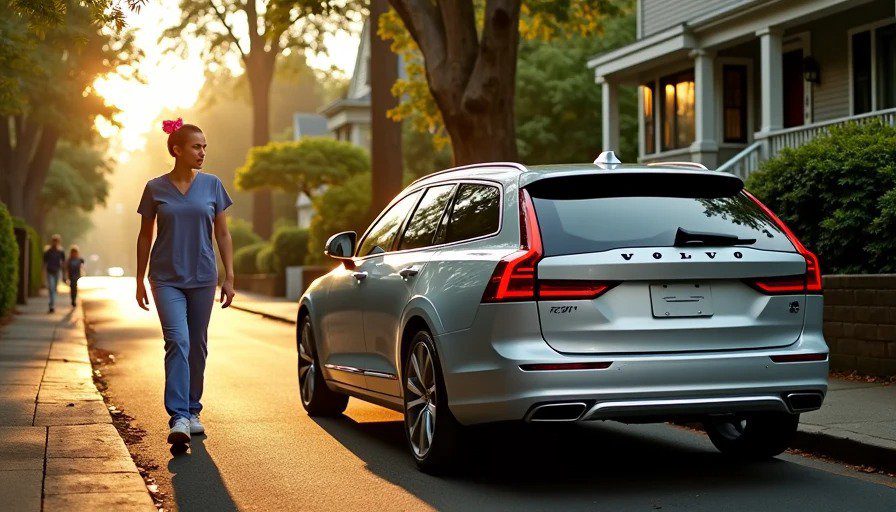
The car is a 2021 V90 T6 Inscription in Birch Light metallic — a pale silver that doesn't shout but catches the light in a way that makes you look twice. The R‑Design would have been sportier, but the Inscription trim is the one you actually want for a family. It's got the Nappa leather, the massaging seats, the Bowers & Wilkins sound system, and the panoramic roof that makes the cabin feel like a greenhouse.
I parked it next to Claire's CR‑V. The contrast was stark — the Volvo is low and long, with a roofline that's almost coupe‑like. It's not a compact car. It's 4.9 metres of Scandinavian design, and it takes up a full parking space without a centimetre to spare.
Mia came out to inspect. She walked around the car twice, then opened the rear door, climbed into her booster seat, and announced: "It smells like a new book."
I honestly don't know if that's a compliment or just a statement of fact. But she didn't complain, and that's a win.
Day 3 — The school run
The V90's party trick is the way it separates adults from children.
I drove Mia to school on Friday morning. The route includes three speed bumps, two roundabouts, and a stretch of road that's been awaiting repaving since 2018. The V90 absorbed all of it without complaint. The suspension is tuned for comfort, not sport — you feel the road, but it's a conversation, not an argument.
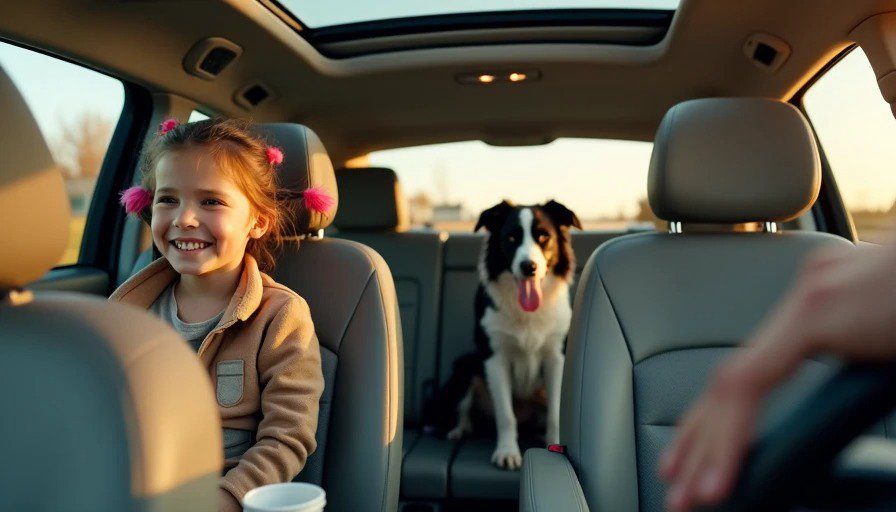
What surprised me was the rear passenger experience. Mia's booster seat sits high enough that she can see out the side windows, and the rear air vents kept her from complaining about being too hot or too cold. She fell asleep on the way home — an activity she generally opposes with the fury of a thousand suns.
For the first time in weeks, she didn't ask for the iPad.
That's not a spec you'll find in the brochure. But it's the one that matters.
Day 5 — The first grocery run
I took the V90 to the Hawthorne Fred Meyer on a Sunday morning. The parking lot is notoriously tight — Portland's city planners designed it in the 1970s, and they clearly didn't anticipate the size of modern cars.
The V90's front and rear parking sensors, combined with the 360‑degree camera, made it manageable. The car is long, but it's also predictable — the steering is light at low speeds, and the turning circle isn't as bad as I expected. I managed a three‑point turn in a space where I'd have struggled in an XC60.
The boot swallowed four full grocery bags, a case of sparkling water, and a bag of dog food with room to spare. The cargo cover retracts at the touch of a button, which is a small luxury, but it's a luxury I appreciated.
Week Two: The Deeper Dive
Day 8 — Claire's commute test
This was the one I'd been waiting for. Claire works twelve‑hour shifts at OHSU, and she's been driving her CR‑V since college. She's not car‑obsessed — she's car‑pragmatic. She drives a car because it's better than walking.
I asked her to take the V90 for a full shift.
Her feedback, on the drive home, was characteristically direct:
"The seats are the best I've ever sat in. I didn't have any lower back pain — and I almost always do after that shift. The steering is light enough that I wasn't fighting it. The heated steering wheel came on automatically, which was nice because it was pouring rain. The navigation took me the long way, but I think that was me, not the car."
"The massage function is a gimmick."
She has a point. The seat massage is nice, but it's not a substitute for a real massage. She used it for the first thirty minutes of the drive, then turned it off.
But the one thing she said that stuck with me was this: "I didn't feel exhausted when I got home. I usually feel like I've been in a fight. This felt like I just... drove home."
That's the V90's quietest achievement. It doesn't give you a rush of adrenaline — it gives you a sense of calm. And for someone who spends twelve hours in a trauma centre, calm is a luxury you can't measure in horsepower.
Day 10 — Socket's cargo test
I took Socket to the dog park in the V90. He's a border collie mix, about 22 kilograms, and he's got more energy than any creature should legally be allowed to possess.
The V90's boot is 560 litres with the seats up — enough for Socket to stand, turn around, and lie down. The cargo cover is sturdy enough that he can't climb over it, and the load height is low enough that he can jump in without assistance.
The problem is the material. The boot floor is carpeted, and Socket's enthusiasm for muddy paws meant that the carpet was, uh, significantly less pristine by the time we returned. The 2021 V90 doesn't have the rubber cargo mat as standard — you need the optional "cargo package" for that. This car didn't have it.
If you're buying a V90 for dog duty, get the rubber mat. Trust me on this.
Day 12 — The Costco test
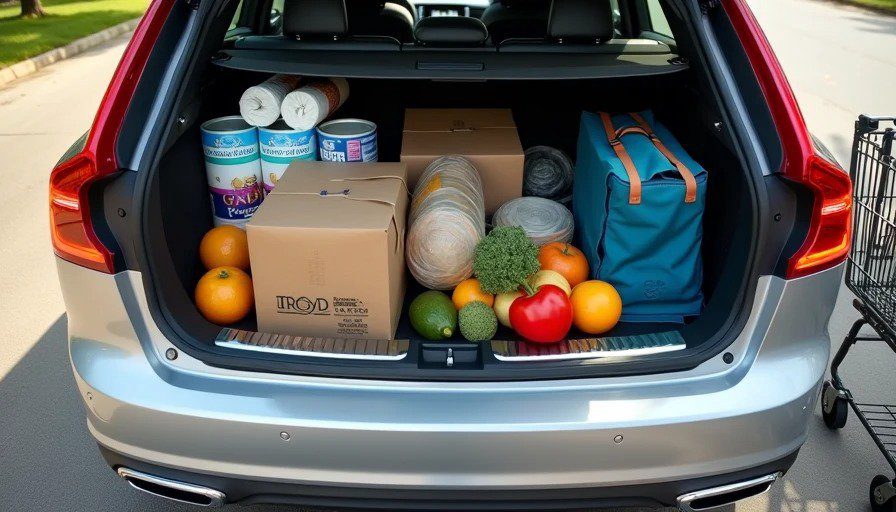
Every family car should pass the Costco test. Can it fit a week's worth of groceries, toilet paper, paper towels, and a 20‑kilogram bag of dog food without making you play Tetris in the car park?
The V90 passed with flying colours. I folded down the rear seats — one easy pull of a lever — and the boot expanded to 1,526 litres. That's more than enough for a full Costco haul, plus a couple of camping chairs, a cooler, and a random bag of mulch that appeared in the cart for reasons I still can't explain.
Loading was easy. The boot opening is wide and low — no lifting heavy items over a high sill. The rear seats fold nearly flat, so there are no awkward angles to navigate.
The only downside was the height. The V90 is low, so if you're used to an SUV, you'll have to crouch a little to reach the rear cargo area. Claire, who's 5'6", had no problem. I'm 5'11", and it was fine. If you're over 6'2", you might find yourself bending a bit more than you'd like.
What worked brilliantly
The Bowers & Wilkins sound system
This is the most expensive audio system you can order in a Volvo — and it's worth every penny. I listened to Fleetwood Mac on the way to the coast, and the soundstage was spectacular. You can hear the instruments separately, but they're perfectly balanced. It's not just loud — it's detailed.
The adaptive cruise control
The V90's Pilot Assist system is one of the best on the market. It's not full self‑driving, but it's close enough that I could relax on I‑5 during rush hour. The lane‑keeping is smooth, the speed adjustments are gentle, and the stop‑and‑go function works in traffic.
The system is also predictable — which matters more than you'd think. A system that brakes late or accelerates too aggressively makes you tense. The V90's system drives like a calm, experienced driver. You trust it.
The 2.0‑litre T6 powertrain
We talked about the Drive‑E engine in the Martin's Bench post, and this is the same unit — the supercharged and turbocharged four‑cylinder with 316 horsepower and 295 lb‑ft of torque. In the V90, it's smooth, responsive, and effortlessly quick.
The car weighs 1,890 kilograms, which is about as heavy as an XC60. The T6 moves it with surprising ease — 0‑60 in about 6.0 seconds, which is quick enough to merge on a short on‑ramp and accelerate out of corners without drama.
The transmission is the Aisin 8‑speed automatic, which is the same unit used in the Lexus RX and the Toyota Supra. It's smooth, and it responds instantly to kickdown.
The only downside is fuel economy. The T6 is rated at 22 mpg combined, and I averaged about 20.5 mpg with Portland's traffic. That's not bad for a car this size, but it's not great either. The T8 plug‑in hybrid would be better, but it's also significantly more expensive.
What didn't work
The touchscreen interface
The V90's infotainment system is a vertical 9‑inch touchscreen that controls everything — climate, audio, navigation, drive modes, and most of the vehicle settings.
It's not the worst system I've ever used. The graphics are clear, the response time is decent, and the layout is logical. But I miss physical buttons. The climate controls are buried in a menu, and adjusting the temperature while driving requires taking your eyes off the road. The heated seat controls are even deeper.
The system also glitched twice during the two weeks. Once, the screen went black for about fifteen seconds. Another time, the rear camera didn't activate when I shifted into reverse. Both times, a reboot fixed it — but it shouldn't happen at all.
The ride height on Portland's roads
Portland's streets are not kind to low cars. The V90's 138mm of ground clearance is enough for most situations, but I scraped the front splitter twice — once on a steep driveway, and once on a speed bump that was bigger than I expected.
If you live in a neighbourhood with aggressive speed bumps, or you park on the street where the curb is high, you'll have to be careful. It's a wagon, not an SUV, and it's not designed to go off‑road.
The sunroof rattle
This is a known issue. The panoramic sunroof in the V90 can develop a rattle around 40,000‑50,000 miles. It's caused by the rubber seals drying out and creating a slight gap between the glass and the frame. The rattle is noticeable on rough roads, and it's annoying in an otherwise quiet cabin.
The fix is a lubricant on the seals and a tension adjustment on the sunroof mechanism. It took me about an hour and cost nothing — but it's a common issue that Volvo hasn't fully resolved.
The repair reality (what I'd tell a customer)
If you're considering a used V90, here's what you need to know from a mechanic's perspective:
The T6 engine is solid. The Drive‑E powertrain is reliable, with the usual supercharger clutch vulnerability. Factor that into your budget — a replacement is about $1,200 at an indie shop. The 2018+ models are better.
The transmission is reliable. The Aisin 8‑speed is a proven unit. Change the fluid at 60,000 miles — it's about $400, and it'll save you a $5,000 transmission replacement later.
The brakes are expensive. The V90 uses the same brake system as the XC90, and the front rotors are 345mm. A full brake job (pads and rotors) is about $1,200. You can save some money by using aftermarket parts, but the OEM brakes are better.
The suspension is robust, but the rear shocks can leak. The self‑leveling Nivomat shocks on the rear are a $1,800‑per‑side repair. They're reliable, but they do fail. Check for signs of leaking oil on the rear shock absorbers when you test‑drive it.
The PCV system needs maintenance. If you hear a whistling sound from the engine bay, it's likely the PCV diaphragm. It's a cheap part and an easy fix, but if you ignore it, it can cause oil leaks.
The final verdict — would I buy one?
The Volvo V90 is not the car for everyone. It's long, it's low, and it's not the most practical choice if you're used to an SUV.
But if you're looking for a family car that doesn't feel like a sacrifice — that makes you feel good every time you open the door, even after a twelve‑hour shift or a bad day at work — the V90 is one of the few that delivers.
It's safe, it's comfortable, it's practical, and it's genuinely beautiful to look at. It's also a car that doesn't shout. It's subtle, it's quiet, and it's confident in its own identity. It's the Scandinavian answer to "Why drive an SUV when you can drive a wagon?"
Claire gave it the final verdict. She said: "I don't want to give it back. But I also don't want to spend $45,000 on a used car. So let me know when a 2019 drops below $30,000."
That's the reality. The V90 is expensive, even used. A 2021 with 40,000 miles still goes for $42,000‑$45,000. A 2019 with 60,000 miles is around $32,000‑$35,000. If you're patient, you can find a good one under $30,000 — but it'll be a 2018 with higher miles and fewer options.
Is it worth it? If you drive one, you'll know. I drove one for two weeks, and I still think about it.
The recommendation: If you're in the market for a luxury wagon and you're willing to spend in the high $30,000 range, the 2020‑2021 V90 T6 is a steal. It's safe, comfortable, surprisingly fun to drive, and one of the most beautiful cars on the road. Just budget for a rubber cargo mat and a sunroof rattle fix.
The alternative: If the V90 is too expensive, the Subaru Outback is the obvious backup — and I'll be writing about it soon.


No signals yet — transmit the first.