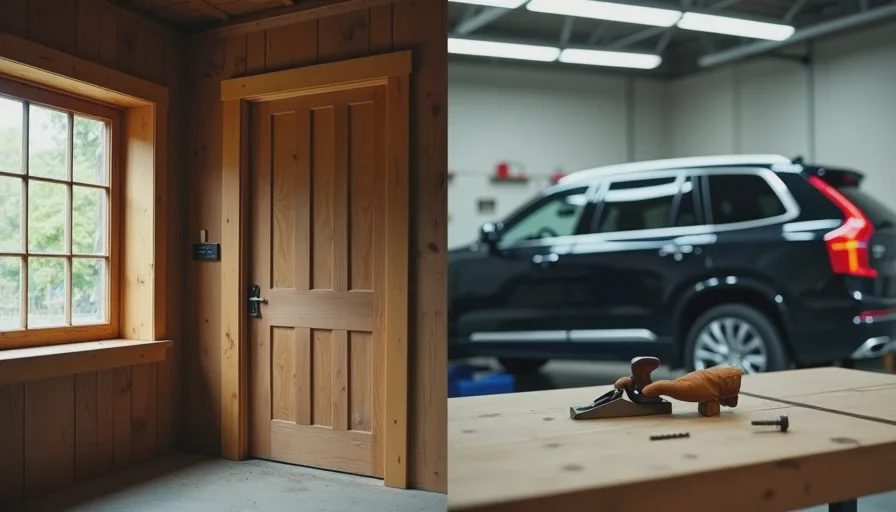
I've been fighting the same door frame for three years.
It's in our 1940s Craftsman house in Southeast Portland. The door frame sits between the kitchen and the living room. It's made of old-growth Douglas fir, the kind of wood they don't cut anymore — dense, straight-grained, and stubborn as hell. It's been out of square since Truman was in office, and I've been trying to fix it.
I've shimmed it. I've planed it. I've replaced the hinges. I've even tried the old carpenter's trick of wetting the wood and clamping it overnight. Nothing works. The door still sticks. The latch still doesn't catch. And every winter, when the humidity rises, it gets worse.
Last week, I was working on a 2018 Volvo XC90. The driver's door hinge was worn — the pin had some play, and the door was sagging about a quarter-inch. The customer asked me to fix it, and I spent about thirty minutes replacing the hinge pins. It was straightforward: remove the old pins, press in the new ones, adjust the door, and torque everything to spec.
The door closed perfectly.
That's when I started thinking about the difference between my Craftsman door frame and that Volvo door hinge. The Volvo hinge is engineered to be repairable — it's designed with serviceability in mind. The Craftsman door frame, on the other hand, was built to last, but it wasn't designed to be adjusted. The wood has moved over time. The house has settled. And there's no fix for that — you just live with it.
That's the thing about German engineering. It's often brilliant, precise, and over-engineered. But sometimes, the best solution isn't the most precise one. Sometimes, the best solution is the one that accepts imperfection — and works anyway.
The Craftsman Door Frame: Lessons in Imperfection
Let me be honest: I love my Craftsman house. The old-growth timber, the hand-planed trim, the built-in bookcases. But the house is a living thing. It breathes. It settles. It shifts with the seasons.
The door frame is a perfect example. It was built in 1940, and it was true then. But over the past 85 years, the foundation has settled, the wood has expanded and contracted, and the frame has moved. It's no longer square. It never will be square again.
I could fix it — if I wanted to spend thousands of dollars and months of work. I could replace the entire frame, level the floor, and rebuild the wall. But the house would still shift. The wood would still move. And in a few years, I'd be back where I started.
So I live with it. I've learned to close the door with a specific technique: lift the handle a quarter-inch, push, and let it drop into place. It's not perfect, but it works. And that's the point.
What woodworking taught me: Perfection is the enemy of good. Sometimes, you have to accept that the solution is good enough — because the pursuit of perfection will cost you more than it's worth.
The Volvo Door Hinge: Lessons in Serviceability
Now let's talk about the Volvo.
The XC90's door hinge is a piece of precision engineering. It's made of high-strength steel, with a hardened steel pin that rides in two bushings. The hinge is designed to last the life of the car — but it's also designed to be repairable.
When the hinge wears, you don't need to replace the entire door. You don't need to cut and weld. You don't need to take the car to a specialist. You just remove the old pins, press in the new ones, and adjust the door.
The whole job took me thirty minutes. The parts cost $60. And the door closed perfectly.
What car repair taught me: Good engineering isn't just about making something that works. It's about making something that can be fixed. A part that's designed to be replaced easily is worth more than a part that's designed to last forever — because nothing lasts forever.
The German Engineering Paradox
Here's where it gets interesting.
German engineering is famous for its precision. BMW, Mercedes, and Audi build cars that are tight, solid, and precise. The panels fit perfectly. The doors close with a satisfying thunk. The interiors are quiet and well-built.
But there's a cost to that precision — and it's not just financial.
The downside of German engineering:
Over-engineering. German cars are often over-engineered. They use complex systems where simpler ones would work just as well. The BMW VANOS system, the Mercedes air suspension, the Audi quattro system — they're all brilliant, but they're also complex, expensive, and prone to failure.
Proprietary parts. German car manufacturers love proprietary parts. You can't just go to an auto parts store and buy a replacement part. You have to go to the dealer — and pay dealer prices.
Difficulty of repair. German cars are often difficult to work on. The engine bays are tight. The parts are buried. The diagnostics require specialist equipment. This is great for dealers (they get to charge you more), but it's terrible for owners.
The "no compromise" philosophy. German engineers don't like compromise. They don't like "good enough." They want perfect. And they're willing to make a car more expensive, more complex, and more difficult to repair to achieve that perfection.
The paradox: The pursuit of perfection leads to cars that are less perfect for the owner. They're brilliant, but they're also needy. They demand attention. They're expensive to maintain. And they can be a nightmare to repair.
The Volvo Alternative

Now let's talk about the car I recommended to my customer.
The Volvo XC90 is a different kind of car. It's built to be safe, comfortable, and durable — but it's also built to be serviceable.
Here's what I noticed:
The oil filter is on top of the engine. You can change it in five minutes, with one hand. In a BMW X5, the filter is buried under the engine cover.
The spark plugs are accessible. You don't need to remove the intake manifold. The plugs are right there, easy to reach.
The timing chain is designed to last. It's a metal chain, not a belt. And it's accessible.
The air suspension (if equipped) is reliable — and repairable. Mercedes's air suspension is notoriously failure-prone. Volvo's is better designed.
The electronics are integrated. Volvo uses a modular approach to electronics. If a module fails, you can replace it individually. In a BMW, you sometimes have to replace the entire system.
What I've learned: Volvo builds cars for people who need to fix them. Not because Volvos are unreliable — but because every car needs to be fixed eventually. And when that day comes, a Volvo is easier to fix.
The German Car I Actually Respect
Let me be clear: I'm not anti-German engineering. I respect it. I admire it. And I think there are some German cars that are genuinely excellent.
The BMW 328i Touring (which I recommended in my wagons post) is one of them. It's built to be reliable, engaging, and well-made. But it's also expensive to maintain — and you need to be prepared for that.
The Mercedes E350 Wagon (also on my wagons list) is another. It's bulletproof. But it's also from a simpler era — the W212 generation is one of the last truly reliable Mercedes-Benz cars.
But here's the thing: the cars I respect most from Germany are the ones that don't try too hard. The ones that accept that perfection is unattainable. The ones that are built to be fixed, not just admired.
What Woodworking and Car Repair Have in Common
I've been woodworking for years, and I've been fixing cars for even longer. And I've learned the same lesson in both:
There's no such thing as perfect. There's only "good enough."
The Craftsman door frame will never be square. I can spend thousands of dollars trying to fix it — or I can learn to live with it.
The BMW X5 will never be perfectly reliable. I can spend thousands of dollars maintaining it — or I can buy a car that's easier to fix.
The old-growth Douglas fir will never be stable. It will always move with the seasons. I can fight it — or I can accept it.
What this means for car buyers: The pursuit of perfection is expensive. If you want a car that's absolutely perfect — perfectly engineered, perfectly built, and perfectly precise — you're going to pay for it. In the purchase price, in the maintenance costs, and in the headaches.
What this means for me: I've learned to appreciate a different kind of perfection. The perfection of a well-maintained car that's easy to fix. The perfection of a car that works well enough — and doesn't demand too much attention.
The Door That Finally Taught Me
I still haven't fixed that Craftsman door frame.
I've accepted it. I've learned to close the door with that specific technique — lift, push, let it drop into place. It's not perfect. It's not even good. But it works.
And that's the kind of car I want to own.
A car that's good enough. A car that works. A car that's easy to fix. A car that doesn't demand perfection — just regular maintenance and a bit of care.
That's why I recommend Volvos. That's why I recommend Mazdas. That's why I recommend Subarus. They're not perfect. But they're good enough.
The Final Verdict
German engineering is brilliant — and it's not always the answer.
Sometimes, the answer is a car that's built to be fixed. Sometimes, the answer is a car that accepts imperfection. Sometimes, the answer is a car that's just good enough.
That's what the Craftsman door frame taught me. And that's what the Volvo door hinge confirmed.
Perfection is overrated. Good enough is underrated. And the best engineering is the engineering that knows what "good enough" means.
Socket doesn't care about door frames. But he cares about doors.
When we're leaving the house, he always looks at the kitchen door. He knows it sticks. He waits for me to lift it. And then he walks through, tail wagging.
He doesn't care that it's not perfect. He just cares that it opens.
That's a good way to live.





No signals yet — transmit the first.