I remember the first time I heard it.
It was a 2016 Volvo XC60 T5, 72,000 miles, owned by a retired teacher who'd bought it used from a dealer in Salem. She brought it to Keller Motor Works because she'd noticed a whistling sound from the engine — high-pitched, like air escaping from a balloon — and the check engine light had just come on.
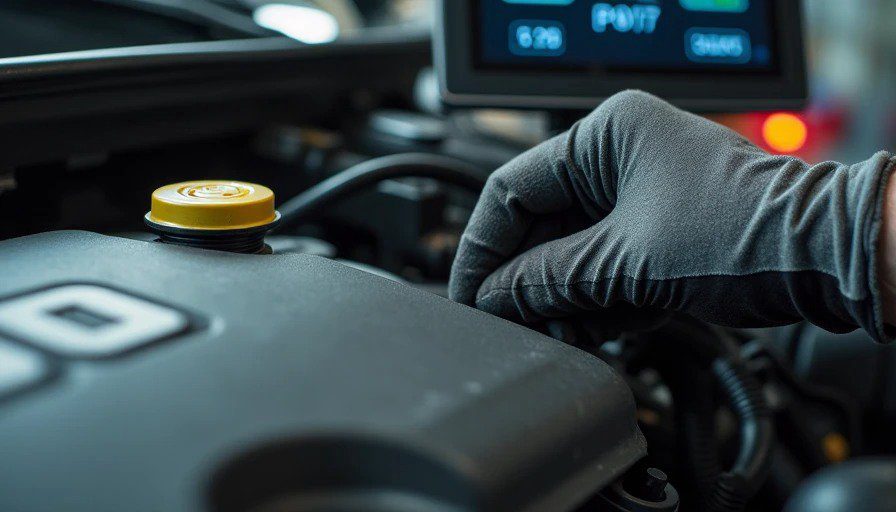
I pulled the oil cap off while the engine was running. It was like opening a shaken soda bottle. The suction was so strong that the cap nearly jumped out of my hand.
"That's not good," I said to my apprentice.
It was the PCV system. And it was failing.
What Is a PCV System?
PCV stands for Positive Crankcase Ventilation. It's not glamorous, and it doesn't sell cars. But it's one of the most important systems in any modern engine.
Here's what happens inside an engine: As the pistons move up and down, a small amount of combustion gas (blow-by) leaks past the piston rings and enters the crankcase — the space below the pistons where the crankshaft lives. This gas is full of unburned fuel, water vapour, and carbon monoxide.
If that gas just stayed in the crankcase, it would mix with the oil, create sludge, and eventually destroy the engine. So every modern engine has a PCV system that:
Vents that gas out of the crankcase.
Separates the oil from the gas (so you don't burn oil).
Recirculates the gas back into the intake manifold to be burned.
It's a brilliant system — it reduces emissions, prolongs oil life, and keeps the engine healthy.
The problem? The PCV system itself can fail. And when it fails on certain Volvo 2.0-litre Drive-E engines, the consequences are catastrophic.
Why Early Volvo 2.0Ts Have PCV Problems
Let's talk about the specific engine — the 2.0‑litre Drive-E four‑cylinder that Volvo introduced in 2013 (and used from 2014‑2018 in the S60, V60, XC60, V40, and S80).
The Drive‑E is a direct‑injection engine. Fuel is sprayed directly into the combustion chamber, at high pressure, through a piezo‑injector. It's efficient and powerful. But it has a side effect: direct‑injection engines produce more blow‑by gas than port‑injected engines.
The blow‑by gas contains a lot of carbon particles. Those particles are abrasive. And they clog things — including the PCV system.
The Drive‑E PCV system is relatively complex. It uses:
A oil separator that spins the gas to remove oil mist.
A diaphragm valve that regulates the flow of gas from the crankcase to the intake manifold.
A heater element that prevents ice from forming in cold climates.
A hose network that routes the gas from the crankcase to the intake.
The weak link is the diaphragm valve.
The diaphragm is a small rubber disc, about 50mm in diameter, that opens and closes to regulate pressure. It's thin, it's plastic, and it's exposed to heat, oil vapour, and carbon particles.
Over time, the rubber degrades. It becomes brittle. It cracks. And when it cracks, the PCV system stops regulating pressure properly.
What Happens When the PCV Fails
There are two failure modes. Both are bad.
Failure Mode 1: The Diaphragm Tears (Low Vacuum)
When the diaphragm tears, the PCV system can't maintain vacuum in the crankcase. The pressure builds up. Oil and sludge start to leak through every seal and gasket.
Symptoms:
Oil leaks: The valve cover gasket, the camshaft seals, the rear main seal — all start to weep oil. Because the crankcase is pressurised, oil is being pushed out.
Oil consumption: You'll burn oil at about 1 quart every 2,000‑3,000 miles. That's not the piston rings — that's the PCV system, pushing oil out of the breather system and into the intake manifold.
Whistling sound: The valve that controls the flow of gas to the intake manifold can whistle when the diaphragm is torn, especially at idle.
Failure Mode 2: The System Clogs (High Vacuum)
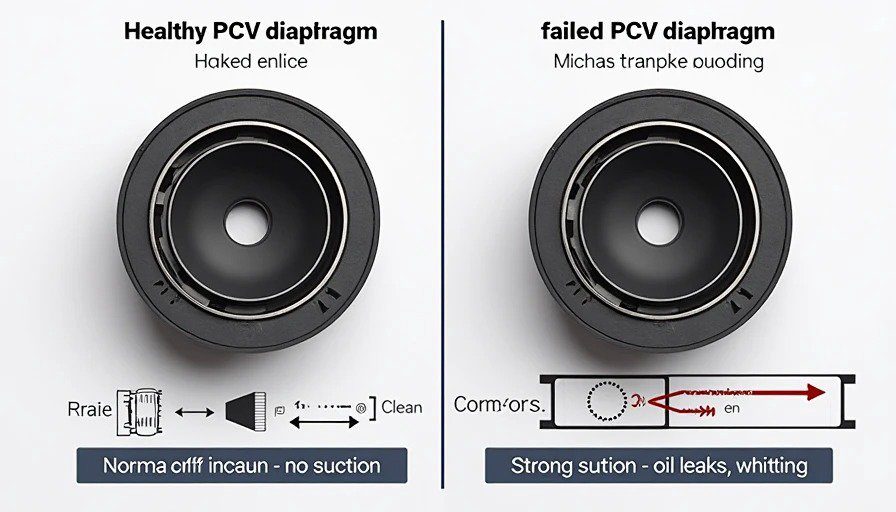
When the diaphragm fails or the oil separator clogs, the PCV system stops venting gas correctly. The engine starts to pull vacuum on the crankcase — and that's much worse.
Symptoms:
Strong suction on the oil cap: This is the classic sign. With the engine running at idle, remove the oil cap. If it's hard to remove, or if you feel a strong vacuum pulling the cap back down, the PCV system is clogged.
Engine runs rough: The vacuum pulls oil mist into the intake, causing rough idling and hesitation on acceleration.
Check engine light: The engine will throw a P0171 (system too lean) or P2187 (system too lean at idle) code — because the unmetered air from the PCV system is messing with the air/fuel mixture.
The worst case: The vacuum builds up to the point where it pulls oil past the piston rings and into the combustion chamber. The engine starts to burn oil — not a little, but a lot. And then you get oil fouling on the spark plugs, misfires, and potentially permanent engine damage.
The Worst Part: It's Not Obvious to Most Drivers
This is the part that frustrates me.
The PCV system starts failing gradually. The diaphragm cracks slowly. The oil consumption increases gradually. The whistling is intermittent. Most drivers don't notice until the check engine light comes on — and by then, the damage is already done.
I've seen three early Drive‑E engines with significant internal damage caused by a clogged PCV system. The oil consumption was so bad that the engines ran low on oil between changes. The piston rings coked up. The valve train started making noise. One engine needed a complete rebuild at 80,000 miles — a $6,000 repair on a car that was worth $15,000.
The saddest part? It was preventable. A $30 part and 30 minutes of labour would have fixed it — if the owner had noticed the symptoms.
How to Check the PCV System on a Volvo 2.0T (Before You Buy)
Here's the good news. You can check the PCV system in about two minutes, with no tools, before you buy any used Volvo with a Drive‑E engine.
Step 1: Start the Engine (Cold)
Let the engine idle. Don't rev it. Let it reach operating temperature. The PCV valve behaves differently when the engine is cold vs. warm. You want to test it warm.
Step 2: Locate the Oil Cap
The oil cap is on top of the engine, directly in the centre. It's a black cap with a yellow ring.
Step 3: Remove the Oil Cap (With Caution)
While the engine is idling, try to remove the oil cap. Do it slowly.
The good result: The cap comes off easily, and there is no suction. If the cap comes off easily and the engine idles smoothly, the PCV system is healthy.
The bad result: The cap is hard to remove — or you feel a strong vacuum pulling it back down. That means the PCV system is clogged or the diaphragm is torn.
The really bad result: The cap comes off, and the engine starts to stumble, shake, or die. That's a sign of a complete PCV failure — the engine is drawing so much vacuum on the crankcase that it's affecting the air/fuel mixture.
Step 4: Cover the Oil Fill Opening (With Your Hand)
Place the palm of your hand over the oil fill opening. You should feel only a slight suction, or none.
The bad result: You feel a strong vacuum that holds your hand tight, and the engine stumbles or shakes. That's the clogged PCV system.
Step 5: Check the Dipstick
Pull the dipstick while the engine is running.
The bad result: Oil sprays out — that's pressurised oil from a clogged PCV system. Also, if the dipstick is hard to pull out, that's also a sign of pressure buildup.
The Fix (And What It Costs)
If you've identified a failed PCV system, you have two options.
Option 1: The diaphragm replacement (the simple fix)
The diaphragm is available from Volvo for about $30.
It's a 30‑minute job if you know what you're doing. The diaphragm sits on top of the engine, under a plastic cover.
Labour at an indie shop: about $150.
Total: ~$180.
Option 2: The oil separator replacement (the comprehensive fix)
If the system is severely clogged, the oil separator itself may be the issue. The separator is part of the valve cover — you'll need a new valve cover assembly.
Parts: about $800 for the complete valve cover with integrated oil separator.
Labour: about 2 hours — $250.
Total: ~$1,050.
The DIY option (if you're handy)
You can replace the diaphragm yourself. The part is cheap, and there are many YouTube tutorials.
But be careful: you need to use the exact diaphragm for your specific engine and year. The part changed in 2018. I've seen people buy the wrong part and end up with the same problem.
Which Years Are Affected?
The PCV issue affects early Drive‑E engines from approximately 2014‑2018.
Model Year | Engine | PCV Issue? | Notes |
|---|---|---|---|
2014‑2015 | 2.0T Drive‑E | Yes | The worst years. Early diaphragm material degraded more quickly. |
2016 | 2.0T Drive‑E | Yes | Volvo updated the diaphragm design, but some cars still have issues. |
2017 | 2.0T Drive‑E | Yes | The issue is less common — but still present. |
2018 | 2.0T Drive‑E | Yes | Some 2018s are affected — but the updated diaphragm was used from late 2018 onward. |
2019+ | 2.0T Drive‑E | Rare | Volvo changed the diaphragm material, and the issue is much less common. |
Important: The PCV issue is not limited to high‑mileage cars. I've seen it on 2015 S60s with only 40,000 miles. It's a wear‑and‑tear part, and it can fail at any time after 30,000‑40,000 miles.
How to Avoid Buying a Car With This Problem
Test the PCV as I described. This is the only way to be sure.
Check the service records. If the car has had regular oil changes (every 7,500‑10,000 miles) with the correct oil, the PCV system is less likely to be clogged. Carbon buildup is accelerated by old, degraded oil.
Look for oil leaks. If the valve cover or camshaft seals are weeping oil, it's a sign that the crankcase is pressurised — which means a PCV issue.
Check the check engine light. If the car has a P0171 or P2187 code, it's likely a PCV issue — but it could also be a vacuum leak or a failing mass air flow (MAF) sensor. Have a mechanic diagnose it properly.
Ask about the PCV system. If the seller doesn't know what it is, or if they've never changed it, the car is more likely to have the issue.
Get a pre‑purchase inspection. Any Volvo specialist will know about the Drive‑E PCV issue. They'll check it as part of the inspection.
What I Tell My Customers
When someone asks me about buying a used 2014‑2018 Volvo with the Drive‑E engine, I give them the straight talk:
"The car is excellent — if you maintain the PCV system. The engine is strong, the transmission is reliable, and the interior is beautiful. But the PCV system is the Achilles heel. If you catch it early, it's a $180 fix. If you ignore it, you're risking an engine rebuild."
"So here's my advice: Get the PCV checked by a Volvo specialist before you buy. If it's healthy, buy the car and replace the diaphragm every 40,000 miles. It's cheap, it's easy, and it'll save you $6,000."
The PCV system on early Volvo 2.0T Drive‑E engines is a known weak point. It's not a design flaw — it's a maintenance item that many owners and dealers ignore.
The good news: It's easy to check. It's cheap to fix. And if you catch it early, there's no permanent damage.
The bad news: If you don't catch it, you're looking at an expensive repair — and a car that's worth less than the cost of the engine.
I've fixed dozens of these. The diaphragm is a $30 part. The job takes 30 minutes. And the result is an engine that lasts.
Don't ignore it.





No signals yet — transmit the first.